How to judge a faceless YouTube niche
Updated TrendGrid4 min read
A practical way to decide whether a YouTube niche can stay faceless: repeatable titles, footage you can source, and a format that does not need a face.
On this page
A topic is a subject. A niche, for a channel, is a subject plus a format plus a viewer who wants that format again next week. "Personal finance" is a topic. "A faceless explainer that walks through one money decision with on-screen text and sources you can name" is closer to a niche.
Faceless only means the host's face is not the product. It does not mean the video is free to make. Voiceover, animation, screen recording, stock footage, and text-on-screen each have a different cost. Judge the format you would actually repeat, not the label.
Four questions before you commit
Ask these in order. If one of them fails, you do not need a longer keyword list.
- Can you name the next fifteen titles? If you cannot, you have a video idea, not a niche. The titles should be variations of one promise, not fifteen unrelated subjects that share a vibe.
- Can you make video two faster than video one? A faceless workflow is a system: a title pattern, a thumbnail pattern, a sourcing method, and an edit template. If every video needs a new pipeline, the niche does not fit a publishing schedule.
- Can you legally get the pictures and the facts? Screen recordings of your own process, original animation, footage you filmed, and material you licensed are workable. Clips taken from other YouTubers are not a business model. YouTube explains the copyright system in its copyright education pages. That is a production constraint, not legal advice. If the niche only works with someone else's footage, it is the wrong niche.
- Does the viewer need a person, or an outcome? Some niches pay off because of trust in a specific human: medical advice, a get-ready-with-me, relationship commentary, anything where the face is the proof. Those are poor faceless fits. Niches that pay off because of a sound, a loop, a clear explanation, a comparison, or a recorded process can work without a host on camera.
What you can actually see
You do not need a private analytics tool for a first pass. You also should not pretend the public site tells you why a video was recommended. You cannot see impressions, click-through rate, or how long people watched.
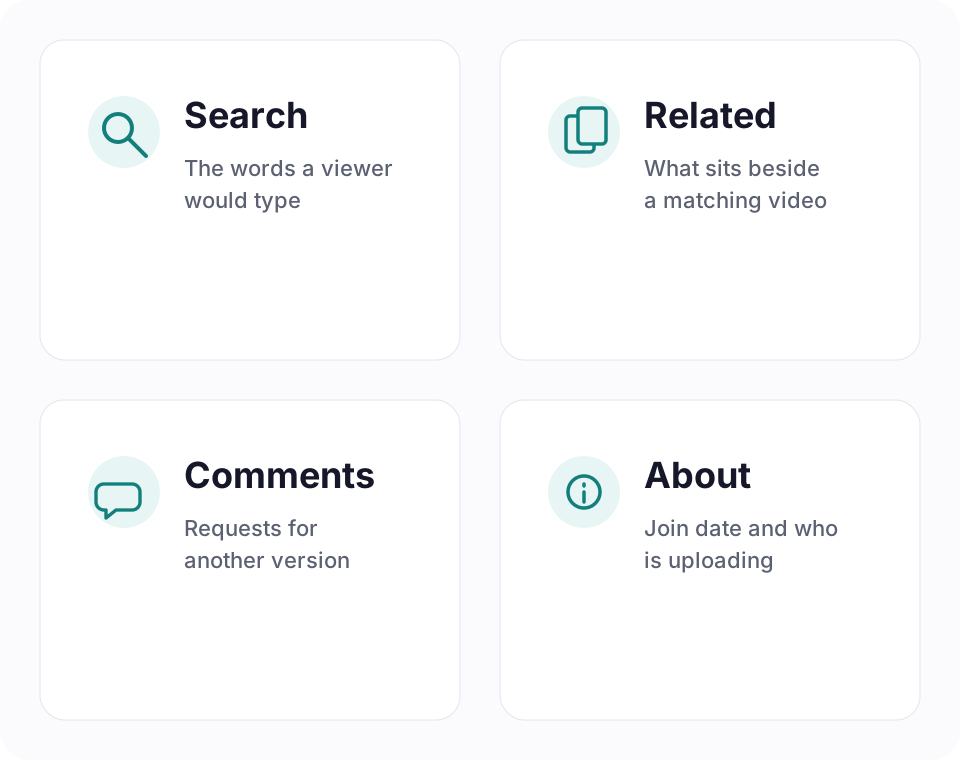
Open YouTube and search a phrase a viewer would type, not a brand name. Then write down only what is on the screen:
- Whether several channels, not one, have published the same kind of video recently.
- Whether those channels look small or new. The About page often shows a join date. A subscriber count is a rough size, not a quality score.
- Whether the titles promise the same outcome in similar words.
- Whether the thumbnails follow a pattern a new channel could imitate without a face.
- Whether comments ask for another version.
Keep the notes in the same shape every time so you can compare them a week later:
Phrase:
Format (length, voice, visuals):
Could I source this without taking clips? yes / no
Could a channel without a face package this? yes / no
Are smaller channels being watched, or only big ones?
Next 5 titles I could publish:
Why I would pass:
None of those lines is a score. A huge view count on a celebrity channel does not mean a new faceless channel can enter. A quiet video does not mean the niche is dead.
A slower comparison
Use this when a niche looks exciting and you need to slow down.
| What you noticed | What it can suggest | What it does not prove |
|---|---|---|
| Several recent uploads in the same format | The format is repeatable right now | That you will be recommended |
| Only one very large channel | The topic may need an existing audience | That the topic is impossible |
| Comments asking for variations | Viewers want more of this job | That those videos will be easy to make |
| Titles you could write 15 of | You may have a series, not a one-off | That the packaging will get clicks |
| Footage you cannot license | The niche fails your production test | Anything about demand |
Red flags that are easy to romanticize
- The niche depends on breaking news you cannot produce the same day.
- The payoff is a personality, a visible transformation, or trust in a credential you do not have.
- "Faceless" in the pitch really means a compilation of other people's videos.
- You would need a different visual style for every upload.
- The only evidence is a single outlier video. One spike is a video. A niche is a pattern.
A niche is a repeatable way to help the same kind of viewer. A trend is a subject that is busy this week. You want a niche that can catch a trend, not a trend standing in for a niche.
Where a tool fits
TrendGrid's job is the research half. It looks for breakout niches aimed at faceless channels and puts a fresh batch in your dashboard, with a daily email on the Pro plan ($9.99 a month). It does not film the video, clear the footage, or decide whether you can live with the format.
If you want a manual habit before you pay for anything, run the four questions on five phrases this week and keep the notes. The niche you can explain in one sentence, source cleanly, and title fifteen times is the one worth a test video. That test — one video, not a thirty-video commitment — is the subject of testing a faceless format before you scale.